
Historic, Shopping, Landmarks
Old Town (Altstadt)
The medieval heart of Bern, a UNESCO World Heritage Site since 1983. Six kilometers of arcaded shopping streets, 100 ornate fountains, and centuries of history packed into one walkable quarter.

Districts
Each district has its own pace. Find the one that fits your mood.
Bern is small, and its character changes block by block. The whole city centre sits inside a tight loop of the Aare, and almost every district worth knowing is within a 20-minute walk or a short tram ride of the next. That makes Bern unusually rewarding to explore on foot: you can start the morning under the sandstone arcades of the Altstadt, drop to the riverside lanes of the Matte, cross the water to the museum quarter in Kirchenfeld, and finish the day with a craft beer in bohemian Lorraine — all without ever needing a car.
This guide walks you through six districts most visitors actually use: the UNESCO Old Town (Altstadt) with its Lauben arcades; the riverside Matte reached by its little lift, the Mattenlift; bohemian Lorraine with the Botanical Garden on its edge; the university quarter of the Länggasse; the elegant museum quarter of Kirchenfeld across the Kirchenfeldbrücke; and laid-back, residential Breitenrain. For each you will find what gives it its character, what to see and eat, who it suits, and how it links to its neighbours on foot. Further down there is a walking route that strings them together and a FAQ covering where to stay and what is most walkable.
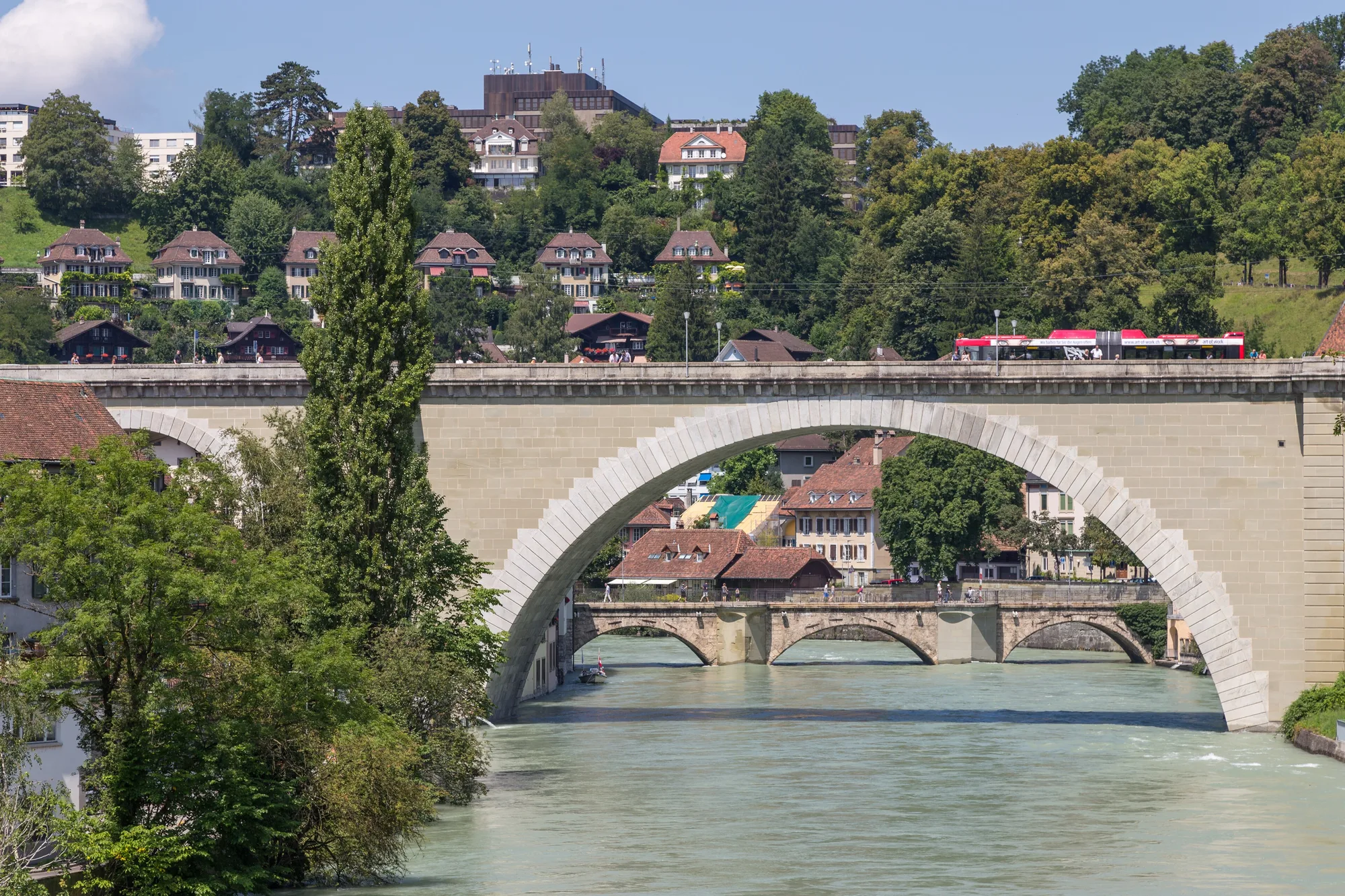
Two neighborhoods that capture what makes Bern special — one on the ridge, one down by the river.
The medieval heart of Bern, a UNESCO World Heritage Site since 1983. Six kilometers of arcaded shopping streets, 100 ornate fountains, and centuries of history packed into one walkable quarter.

Historic working-class neighborhood along the Lower Aare, now a trendy district with artisan workshops, independent boutiques, and cobblestone lanes where craftspeople still practice traditional trades.

The Aare carves through the city, shaping every neighborhood it touches.
Beyond the center, each district rewards the curious with its own rhythm and hidden corners.

Alternative Culture, Art, Diversity
Multicultural artistic quarter with street art, alternative culture, and a diverse food scene. Vintage shops and creative venues attract artists and free spirits.

Student Life, Dining, Nightlife
Vibrant student quarter near the university, known for multicultural restaurants, independent cafés, and nightlife. Affordable dining and creative energy.

Museums, Embassy Quarter, Elegant
Elegant residential district south of the Aare, home to embassies, museums, and grand Belle Époque architecture. Quieter and more refined.

Residential, Local Restaurants
Residential neighborhood with excellent local restaurants, hidden garden cafés, and a weekly market. Less touristy but rich in authentic Bernese atmosphere.

Multicultural, Affordable
Diverse outer district with a growing cultural scene, international food options, and a more affordable cost of living. A neighborhood in transition.

Nature, Family, Views
Gateway to Bern's house mountain, the Gurten. Quiet, leafy, and family-friendly with panoramic views of the Alps and easy funicular access to the summit park.

Village Feel, Castle, Trails
Charming municipality on Bern's southern fringe with a village feel, walking trails, and a medieval castle. Close enough to commute, far enough to breathe.
This is the Bern of postcards: a UNESCO World Heritage Site since 1983, built along a sandstone spine that runs from the Bahnhof down Marktgasse and Kramgasse to the Nydegg and the river. Its signature is the Lauben — roughly six kilometres of covered arcades that let you shop, browse and cafe-hop in any weather, among the longest sheltered promenades in Europe. Threaded through it are the eleven painted Renaissance fountains and the Zytglogge clock tower.
What to see and eat: the Zytglogge show on the hour, the Justice and Child-Eater fountains, the Münster (Switzerland's tallest cathedral tower), and arcade restaurants serving fondue and rösti. Who it suits: first-timers who want everything on the doorstep and don't mind paying centre prices. On foot:you are already in the middle of everything — the river, Matte and Bear Park are all downhill to the east. Dig deeper in the Old Town guide and the arcades guide.
Tucked below the Old Town on the bank of the Aare, the Matte is the city's historic working-class and craftspeople's quarter — once a district of mills and tanneries, now a quiet, characterful warren of low houses and cobbled lanes right at water level. It even has its own dialect lore (Mattenenglisch). The charm is the change of scale: you drop out of the grand arcades into something intimate and almost village-like beside the rushing river.
What to see: the riverside walk, the weir and terrace at Schwellenmätteli, and the Mattenlift — a small public lift that hauls you back up the cliff to the Münster platform, saving the climb. Who it suits: walkers and photographers who want the Old Town's quiet underside and a foot in the river world. On foot:steps and the lift connect it to the cathedral above; the Bear Park is a short stroll along the bank. See the Matte district guide.
Across the river to the north, Lorraine is Bern's alternative, multicultural quarter: street art, co-ops, vintage shops, a diverse and affordable food scene, and a relaxed creative energy a world away from the polished centre. On its edge, dropping toward the Aare, lies the University of Bern's Botanical Garden (BOGA) — free, open daily, with glasshouses and a riverside setting that make it a favourite green escape.
What to see and eat: the Botanical Garden, independent cafes and ethnic kitchens, and the riverbank itself. Who it suits: travellers who like their neighbourhoods scruffy and real, with cheaper eats and a younger crowd. On foot:a short walk over the Lorrainebrücke from the station puts you right in it. See the Lorraine guide and the Botanical Garden details.
North-west of the centre, the Länggasse is Bern's student district, shaped by the University of Bern. It has the energy you would expect: independent cafes, multicultural and budget-friendly restaurants, bookshops and an easy-going nightlife, all in handsome turn-of-the-century streets. It is residential and unpretentious, the kind of area where you see how the city actually lives rather than how it presents itself to visitors.
What to see and eat: affordable, varied dining; lively cafes; and a stroll through grand Belle Époque housing. Who it suits: value-minded travellers and anyone who likes a local, lived-in atmosphere within a short walk of the Old Town. On foot: roughly ten to fifteen minutes from the station to the heart of the quarter, with trams if you would rather ride. See the Länggasse guide.
Cross the high Kirchenfeldbrücke south of the Old Town and you reach Kirchenfeld, an elegant, planned 19th-century district of grand Belle Époque villas, embassies and Bern's densest cluster of museums. It is quieter and more refined than the centre — leafy, residential, and home to the Bernese History Museum (with its Einstein Museum), the Natural History Museum, the Alpine Museum and more, with the Museum of Communication nearby.
What to see: a full day of museums clustered within a few blocks, plus the view back over the Aare and Old Town from the bridge. Who it suits: culture lovers, families on a rainy day, and travellers who want a calm, dignified base a short walk from the action. On foot: five to ten minutes across the bridge from the centre. See the museums overview and best museums.
North-east of the centre, beyond the railway, Breitenrain (locals say “Breite”) is a comfortable residential district that visitors rarely reach — which is exactly its appeal. It has a genuine neighbourhood feel: good local restaurants, hidden garden cafes, a weekly market, and the broad green of the Rosengarten on its southern edge. There is nothing to “tick off” here, just authentic Bernese daily life and excellent eating.
What to see and eat: neighbourhood bistros and cafes, the Wankdorf and market squares, and the easy walk up to the Rosengarten viewpoint. Who it suits:repeat visitors and anyone who wants to eat where locals do, away from the crowds. On foot: a 15-minute walk or a quick tram from the station; it sits just above the Old Town across the tracks. Combine it with local favourites and the Rosengarten.
Because everything sits within the Aare loop, you can link the districts into one easy day on foot. A natural route: start at the Bahnhof and walk the Old Town spine east (Marktgasse, Kramgasse, Gerechtigkeitsgasse) to the Nydegg. From there, drop down into the Matte by the river, ride the Mattenlift back up to the Münster platform, then cross the Nydeggbrücke to the Bear Park and climb to the Rosengarten and Breitenrain for the panorama.
For the other half of the city, the bridges do the work: the Kirchenfeldbrücke carries you south to the museum quarter in five minutes, while the Lorrainebrücke just north of the station drops you into Lorraine and toward the Botanical Garden. The Länggasse spreads out west of the station. None of these crossings is more than 10–15 minutes of flat walking, and the views from the high bridges over the turquoise river are part of the pleasure.
When you would rather ride, trams and buses are frequent and the city is small; an overnight stay gives you a free Bern Ticket that covers all of it plus the funiculars. See walking routes, the Old Town walking tour, and the Bern Ticket guide.
Each quarter has its own table. In the Old Town, the arcades and cellars hide traditional Bernese kitchens — fondue and rösti in vaulted rooms, classic cafes for coffee and Läckerli, and atmospheric wine bars tucked underground. It is the most touristed, so prices run high, but the setting is unbeatable. Down in the Matte, the draw is the riverside terrace at Schwellenmätteli, where you eat with the Aare rushing past below.
Lorraine and the Länggasse are where to head for value and variety: multicultural kitchens, student-priced plates, independent third-wave coffee and craft beer, all without the centre's markup. Breitenrain rewards anyone who walks a little further with genuinely local bistros and hidden garden cafes, plus its weekly market. Across the river, Kirchenfeld is quieter on the food front — museum cafes and a few refined spots — but it is a five-minute walk back to anything you fancy. For the full picture, browse our food guide, best Old Town restaurants, best cafes and the farmers' markets.
A few durable food traditions cut across all the districts. The painted-fountain squares — Bärenplatz and Münstergasse especially — host the city's produce markets, the best place to assemble a picnic for the riverbank or the Gurten. Fondue and raclette are winter staples, while summer belongs to riverside grills and arcade terraces. And wherever you are, the Swiss habit of an apéro — a pre-dinner drink with small bites — is the gentlest way to slip into local rhythm. See Swiss cuisine and best fondue.
Bern is compact enough that no central choice is “wrong” — you can walk between districts in minutes — so pick by the atmosphere you want and your budget. For a full breakdown of areas and hotel types, see our where to stay guide.
Old Town — walking distance to all major attractions, atmospheric setting, but higher prices. Book early for best locations.
Länggasse or Kirchenfeld — short walk or tram ride to Old Town, better prices, more local atmosphere, excellent dining options nearby.
Kirchenfeld — museum quarter with easy access to major cultural institutions. Elegant, quiet, and refined.
Lorraine or Matte — artistic, multicultural, with independent shops and creative energy. Authentic local experience.
If you want the postcard and everything on your doorstep, the Old Town is the obvious answer — just expect centre prices and a few crowds. For your first visit, that trade is usually worth it. If you would rather have character and value, with the sights still a short walk away, the Länggasse (student energy, good cheap food) and Kirchenfeld (calm, elegant, museums next door) are the smart picks. For an alternative, lived-in feel, Lorraine and the Matte trade polish for atmosphere, while Breitenrain is for repeat visitors who want to eat and live like a local.
The reassuring truth is that Bern is so compact that almost any choice works: you can change districts in the time it takes to finish a coffee. Pick the mood you want for your evenings — grand and historic, studenty and cheap, refined and quiet, or scruffy and creative — and let the walkability take care of the rest. Pair this with our first-time guide, things to do and where to stay to lock in your plan.
For a first visit, the Old Town puts everything on your doorstep, though it carries centre prices. For better value with the centre still a short walk away, look at the Länggasse or Kirchenfeld; for an alternative, local feel, Lorraine or the Matte. Whichever you choose, you are rarely more than 15 minutes' walk from the main sights. Our where to stay guide goes area by area.
The Old Town is the most walkable in Switzerland by reputation — it is largely car-free, flat along its spine, and sheltered by six kilometres of arcades, so weather barely matters. But the whole city is walkable: every district covered here is within 10–15 minutes of the centre on foot.
Kirchenfeld is ideal for a rainy day with its cluster of museums, while the Old Town keeps the Bear Park, fountains and clock-tower show within easy reach. For green space and a playground, base near the Gurten side or the Rosengarten in Breitenrain. See things to do with kids.
Beyond the tourist core, the Länggasse, Lorraine and Breitenrain are where everyday Bern happens — affordable kitchens, independent cafes, neighbourhood bars and weekly markets. The Marzili lawns by the river fill with locals all summer. See local favourites and hidden gems.
On foot, mostly — the bridges and the Old Town spine connect everything in minutes. When you want to ride, the tram and bus network is dense and reliable, and an overnight stay gives you a free Bern Ticket that covers it. See the transport guide and Bern Ticket details.
Keep exploring Bern with guides that pair well with this one.


