
History
Kindlifresserbrunnen
Meaning, history, and how to find Bern's most unsettling fountain
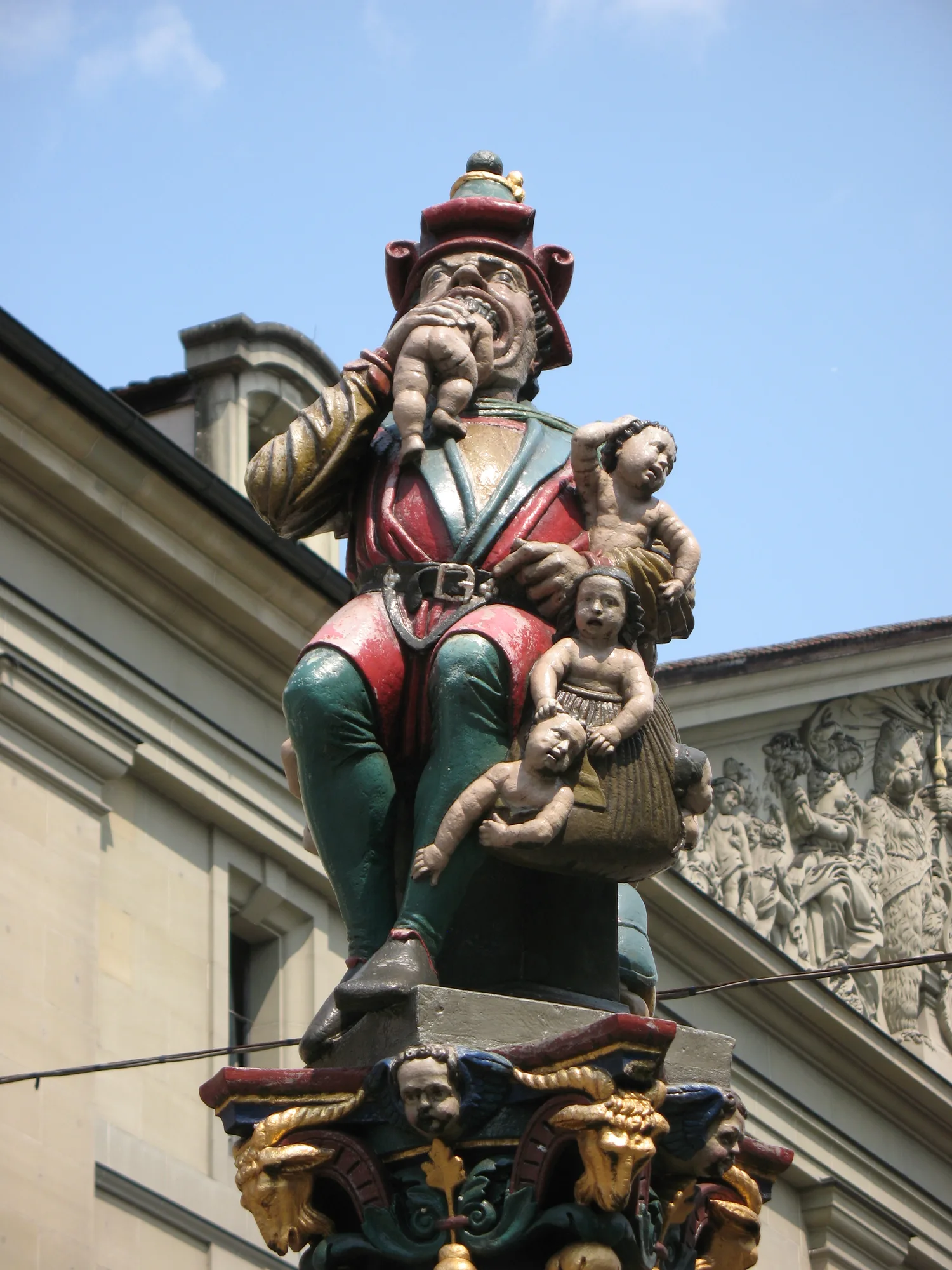
Bern has painted fountains everywhere—colourful statues that turn ordinary streets into an open-air gallery. Then there is the Kindlifresserbrunnen, the "Child-Eater Fountain," which stops even the most casual wanderer in their tracks. A seated ogre is calmly devouring a child while clutching a sack of more, and the scene is rendered in cheerful, fairground colour—which only makes it stranger. It is disturbing, mysterious, and oddly magnetic: one of the Old Town's most photographed and most debated details.
The hard facts are clear enough. The figure was carved in 1545–46 by Hans Gieng of Fribourg, the sculptor behind most of Bern's painted Renaissance fountains, replacing an earlier wooden fountain on the same spot. The fountain was originally just the "Platzbrunnen" (square fountain); the grim nickname Kindlifresser—Swiss German for "little-child eater"—is recorded only from 1666. What the ogre is supposed to mean, though, has never been settled, and that unresolved quality is exactly what gives the fountain its grip.
What you actually see
- The ogre himself: a seated giant in a pointed cap, mid-meal, biting into a small naked child.
- The sack at his side, stuffed with more children awaiting the same fate—the detail that turns unease into horror.
- The painted column below, ringed with a frieze of armed bears marching to war, complete with a piper and a drummer—Bern's heraldic animal at play even here.
- The bright, almost toy-like colour scheme, restored over the centuries, which sits so oddly against the subject.
- Its setting on Kornhausplatz, beside the Kornhaus and a short step from the Zytglogge, so you pass it on almost any Old Town walk.
Take a slow lap of the column before you read into it. The bear frieze, the sculptor's detailing and the paintwork reward a closer look, and the fountain reads completely differently from each side.
What does it mean? (The honest answer: nobody is sure)
There is no single, universally accepted interpretation, and reputable sources are careful to present several possibilities rather than declare a winner. The fountain's power comes precisely from that ambiguity—an image that refuses to settle into one neat explanation. The theories most often discussed are:
- A carnival bogeyman: the simplest reading—a Fasnacht (carnival) figure or a child-frightener, the kind of monster invoked to scare little ones into behaving.
- The titan Cronus (Saturn): the Greek god who devoured his own children, a classical motif about time consuming everything that European Renaissance art knew well.
- An outsider or enemy figure: some have read the ogre as a personified threat to the Swiss Confederacy, or even as a caricature of a specific contemporary figure.
- A darker reading: because the ogre wears a pointed hat, a long-standing strand of speculation links the image to medieval antisemitic "blood libel" imagery—an interpretation that is contested and that we flag rather than endorse.
The honest position is that the evidence is thin and the readings conflict. The best approach is to see the fountain in person, weigh the theories for yourself, and treat it as a window into how Bern used public art to tell stories—because in this city the statues are rarely "just decoration."
Where it fits in Bern's fountain story
The Kindlifresserbrunnen is one of eleven painted Renaissance fountains that crown the Old Town's columns, most of them carved around 1545 and most by Hans Gieng. Where its neighbours broadcast clear civic messages—the Gerechtigkeitsbrunnen shows Justice judging even popes and emperors, the Mosesbrunnen carries the Ten Commandments in front of the cathedral—the Child-Eater is the outlier whose message has slipped away over time.
That contrast is the reason to see it as part of the wider set rather than in isolation. Walking from a fountain you can "read" straight to one you can't is what makes Bern's street sculpture feel alive: a row of confident allegories, and then, on Kornhausplatz, a riddle the city has carried for centuries.
How to include it in a fountain walk
The fountain is most memorable when it arrives as a turn in a bigger story: arcades, the clock tower, painted figures you can decode—and then suddenly a statue that looks like a medieval nightmare. Pair it with the Old Town's other allegorical fountains to see how the city used public art as messaging.
- Use the Old Town walking tour for the route framework.
- Go deep on the full set in our Historic Fountains of Bern guide.
- It sits a minute from the Zytglogge clock tower—an easy pairing.
- Add the covered arcades (Lauben) that link the fountains together.
Frequently asked questions
Where is the Kindlifresserbrunnen?
On Kornhausplatz in Bern's Old Town, beside the Kornhaus building and about a minute's walk north of the Zytglogge clock tower. It's free to see and stands on an open public square, so there's no ticket and no opening hours.
How old is it, and who made it?
The painted figure was carved in 1545–46 by Hans Gieng of Fribourg, the sculptor responsible for most of Bern's Renaissance fountains. It replaced an earlier wooden fountain on the same spot.
So what does the ogre actually mean?
Nobody knows for certain. The leading ideas are a carnival child-frightener, the child-devouring titan Cronus, or a personified enemy; a contested strand reads the pointed hat as antisemitic imagery. The meaning is genuinely unresolved, and the fountain's mystery is part of its appeal.
Why is it called "Kindlifresser"?
"Kindlifresser" is Swiss German for "little-child eater." The fountain was originally just the Platzbrunnen (square fountain); the grimmer nickname is only documented from 1666, well after it was carved.
Is it suitable for children?
Most kids find it more fascinating than frightening, and the bright colours and bears around the base soften the scene. Use your judgement for sensitive little ones—but for most families it's a memorable, talked-about stop.
More Old Town stories

Next reads
Keep exploring Bern with guides that pair well with this one.


