
History
Historic Fountains
Colorful guardians of Bern's streets
Bern's Old Town is dotted with more than a hundred public fountains, but eleven of them are something else entirely: tall stone columns crowned with brightly painted allegorical figures, standing mid-street like a row of characters in an open-air theatre. Most were carved in the 1540s—around 1545—and the great majority are the work of one sculptor, Hans Gieng of Fribourg, who seems to have worked in Bern in that decade. They are part of what UNESCO singled out when it inscribed the Old City of Berne on the World Heritage List in 1983.
These figures were never merely decorative. In a confident, newly Protestant city, they advertised Bern's wealth and self-image and broadcast moral and political messages to anyone walking past: justice that applies to kings and commoners alike, strength, civic duty, biblical virtue. The water mattered too—the fountains were a working supply for a growing town. That practical role survives: the water in Bern's street fountains is fresh and, where not signed otherwise, drinkable, so a reusable bottle is genuinely useful on a fountain walk.
The painted eleven, figure by figure
Zähringerbrunnen — Kramgasse
An armoured bear—shield, helmet and pennant, a bear cub at its feet—honouring Berchtold V of Zähringen, the duke traditionally named as Bern's founder. It is the city's emblem in fountain form: the bear is Bern's heraldic animal, and here it stands as a soldier. Unlike most of the set, this figure is attributed to Hans Hiltbrand (1535) rather than to Gieng.
Gerechtigkeitsbrunnen (Fountain of Justice) — Gerechtigkeitsgasse
The most pointedly political of all. Lady Justice stands blindfolded with sword and scales—and at her feet sit four heads of power: a pope, an emperor, a sultan and a city mayor. The message is blunt for the 1540s: justice weighs everyone the same, however high their station. It is one of the great early-modern depictions of Justice anywhere in Europe.
Kindlifresserbrunnen (Child-Eater Fountain) — Kornhausplatz
The strange one. A seated ogre devours a child while clutching a sack of more—an image that stops every passer-by. Its meaning is genuinely unresolved: a carnival bogeyman, the Greek titan Cronus, and other readings have all been argued, and no single explanation is accepted. We dig into the theories on its own page.
Simsonbrunnen (Samson Fountain) — Kramgasse
The biblical strongman Samson forcing open a lion's jaws—raw strength as a civic virtue. It's an easy figure to read and a favourite for photos, set among Kramgasse's arcades.
Mosesbrunnen (Moses Fountain) — Münsterplatz
Moses holding the tablets of the Ten Commandments, standing in the square in front of the cathedral. Its place here is no accident: it speaks directly to the religious values of Bern after the Reformation.
Pfeiferbrunnen (Bagpiper Fountain) — Spitalgasse
A wandering musician in colourful dress playing the bagpipes—often linked to images after the engraver Urs Graf. One of the most cheerful figures in the set and a good first stop coming in from the station end.
Schützenbrunnen (Marksman Fountain) — Marktgasse
A confident standard-bearer marksman, with a small bear cheekily firing a gun at the column's base—a nod to Bern's tradition of citizen militias and shooting societies.
Anna-Seiler-Brunnen — Marktgasse
A rare fountain honouring a real local figure: Anna Seiler, who in 1354 endowed the hospital that grew into Bern's civic medical care. The allegorical woman with a bowl stands for temperance and charity.
Läuferbrunnen (Messenger Fountain) — Läuferplatz
A city runner or herald in mid-stride near the Untertorbrücke and the lower Old Town—a reminder of the era when fast messengers on foot were how a city-state stayed in touch with its territory.
Vennerbrunnen (Banneret Fountain) — Rathausplatz
A Venner—a banneret, one of the city's senior elected officials and militia captains—in full armour with Bern's flag, standing right by the town hall. Civic authority, made literal.
Ryfflibrunnen — Aarbergergasse
A crossbowman, said to recall a marksman of local legend—another nod to Bern's shooting and militia culture, tucked onto the quieter Aarbergergasse away from the main drag.
Note on attribution and dates: most of the painted figures are the work of Hans Gieng around 1545; a few, such as the Zähringerbrunnen (1535), are by other hands. The columns and basins were often re-set or restored over later centuries, and the bright paintwork has been renewed many times, which is why the colours look so fresh today.
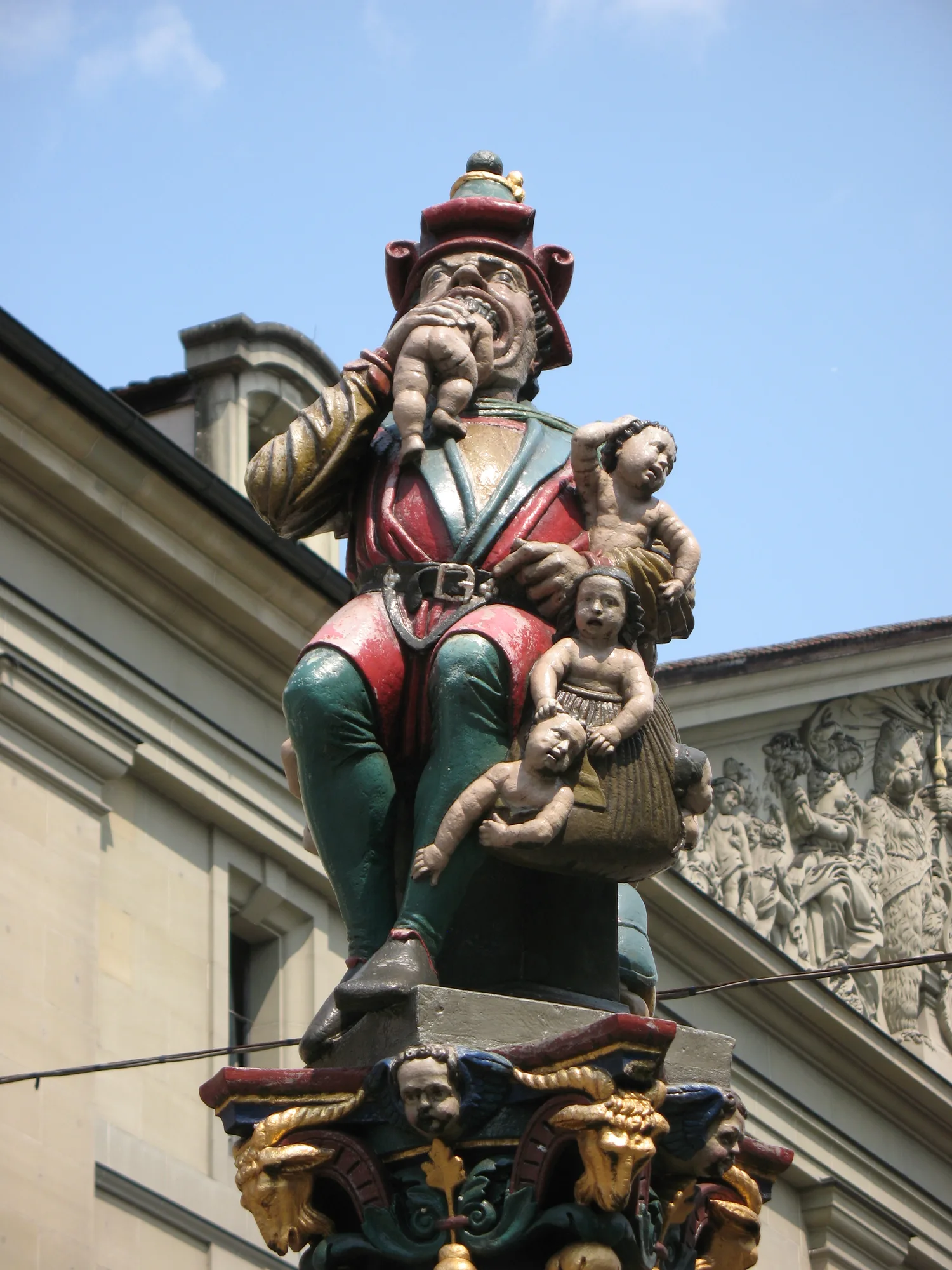

The infamous Kindlifresserbrunnen on Kornhausplatz
A self-guided fountain walk
The good news is that you don't need a tour: the fountains line up along the Old Town's spine, so a single straight walk catches most of them. Start at the station end on Spitalgasse (Pfeiferbrunnen), continue through Marktgasse (Schützenbrunnen, Anna-Seiler-Brunnen) past the Käfigturm, then carry on along Kramgasse for the Zähringerbrunnen and Simsonbrunnen. From there the street becomes Gerechtigkeitsgasse, where the Fountain of Justice stands, and drops toward the lower Old Town and the Läuferbrunnen.
Two of the best require a short detour off the main line: the Kindlifresserbrunnen on Kornhausplatz (a block north) and the Mosesbrunnen on Münsterplatz, in front of the cathedral. Allow one to two hours if you want to read each figure and photograph them properly. Morning light is kindest on the painted statues, and the streets are quieter before the shops fill up.
Local tip: the water in these fountains is fresh Alpine supply and, where a sign doesn't say otherwise, drinkable—so bring a reusable bottle and refill as you go.
Frequently asked questions
How many fountains does Bern have?
More than a hundred public fountains stand in the Old Town. Eleven of them carry the famous painted Renaissance figures—those are the ones visitors come to see—while the rest are simpler working fountains.
Who made the painted figures, and when?
Most were carved around 1545, and the majority are attributed to Hans Gieng of Fribourg, who worked in Bern in that decade. A few are by other hands—the Zähringerbrunnen (1535), for example, is credited to Hans Hiltbrand.
Can you drink the fountain water?
Generally yes—Bern's street fountains run fresh Alpine water and, unless a fountain is specifically signed as non-potable (kein Trinkwasser), it's drinkable. Bring a reusable bottle.
Do I need a guided tour to see them?
No. The main fountains line up along one walkable axis through the Old Town, so a self-guided stroll covers them in an hour or two. A guide adds detail and stories, but isn't necessary to enjoy them.
Which is the "must-see" fountain?
The Gerechtigkeitsbrunnen (Justice) for its message and craftsmanship, and the Kindlifresserbrunnen (Child-Eater) for sheer strangeness. Seeing them back to back captures the full range—from civic virtue to medieval nightmare—in a single short walk.
Next reads
Keep exploring Bern with guides that pair well with this one.


